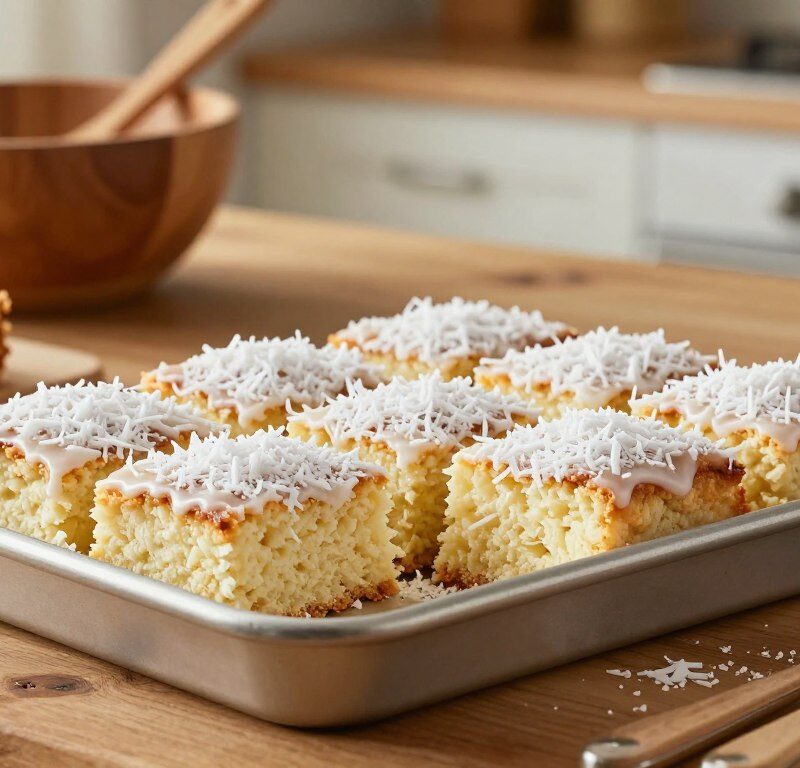
This classic British favourite is a light, moist sponge topped with a sweet icing and a generous scattering of desiccated coconut. It has a gentle vanilla aroma that makes it perfect for afternoon tea or a school fundraiser.
The all-in-one method keeps the process simple, so both beginners and seasoned bakers can rely on consistent results. With a straightforward recipe and budget-friendly ingredients, this cake holds its shape well and slices neatly for sharing.
Key Takeaways
- Simple technique: an all-in-one method ideal for home baking.
- Great flavour: a fragrant vanilla base with a sweet icing finish.
- Family friendly: suitable for school events and afternoon tea.
- Consistent results: reliable texture that slices cleanly.
- Budget wise: inexpensive ingredients with lovely flavour.
Why Everyone Loves the Mary Berry Coconut Tray Bake
You’ll find this cake popular because it slices neatly, travels well and tastes comforting.
The appeal is easy to see. The sponge stays soft and moist, yet firm enough to cut into tidy squares for parties or school events.
Practical and forgiving: the all-in-one method reduces steps and mistakes. That simplicity delivers a reliably light crumb every time you are baking.
The balance of sweet icing and desiccated coconut adds flavour and texture without overwhelming the sponge. Its shape holds up well when transported, so presentation stays intact.
- Soft, nostalgic sponge that suits all ages.
- Neat squares for sharing and serving.
- Consistent results from a straightforward method.
| Feature | Benefit | Best For |
|---|---|---|
| All-in-one method | Easy and consistent | Bake sales, beginners |
| Light, moist crumb | Comforting texture | Afternoon tea |
| Holds shape | Transport-friendly | Picnics and parties |
Essential Ingredients for Your Sponge
Gathering the right ingredients sets the stage for a light, classic sponge every home baker will enjoy.
For the sponge: you will need 225g self-raising flour, 225g caster sugar, and 225g softened butter. These three form the base of the cake and give a tender crumb.
Add 4 large eggs for structure and richness. Mix in 2 tsp baking powder to ensure an even rise and 2 tsp vanilla for warm aroma.
Stir in 2 tbsp milk to reach the right batter consistency. Using room-temperature butter helps the mixture incorporate smoothly during beating.
- Quality ingredients: simple, budget-friendly and widely available.
- Balance: each component contributes to texture and flavour.
- Easy to scale: straightforward quantities for home baking.
| Ingredient | Amount | Role |
|---|---|---|
| Self-raising flour | 225g | Structure and lift |
| Caster sugar | 225g | Sweetness and fine crumb |
| Softened butter | 225g | Moisture and richness |
| Eggs | 4 large | Binding and rise |
| Baking powder | 2 tsp | Lift |
| Vanilla extract | 2 tsp | Flavour |
| Milk | 2 tbsp | Adjusts batter consistency |
Preparing Your Baking Tin and Oven
Start with the kit: the correct tray dimensions, baking parchment and oven settings set you up for success.
Setting the Correct Temperature
Use a 30x23cm traybake tin and line it with good-quality tin baking parchment. This simple step prevents sticking and keeps edges tidy when you turn out the cake.
Preheat your oven to 160°C (fan) or 180°C (conventional). Allow the oven to reach temperature before the batter goes in so heat is stable.
- Prepare the 30x23cm tin with tin baking parchment to ensure the sponge releases smoothly.
- Set the oven to 160°C fan or 180°C conventional for even rising and a steady bake.
- Good parchment and correct traybake tin baking dimensions produce an even thickness for neat squares.
- Monitor the oven so the coconut sponge can rise without sinking.
“A well-prepared tin often saves more time than rushed baking.”
| Item | Action | Benefit |
|---|---|---|
| 30x23cm tin | Line with parchment | Easy release and neat slices |
| Oven | 160°C fan / 180°C conventional | Stable, even heat for an even rise |
| Parchment | Use quality paper | Prevents sticking; retains shape |
Take a few extra minutes to prepare equipment. These small checks make removing and slicing the mary berry coconut traybake much easier and ensure a professional finish.
Mixing the Perfect Batter
A well-prepared batter starts when you beat everything together until it turns pale and creamy.
For the mary berry coconut recipe, combine the flour, caster sugar, butter, eggs, baking powder, vanilla and milk in one bowl. Use room-temperature ingredients so the fats and liquids blend smoothly.
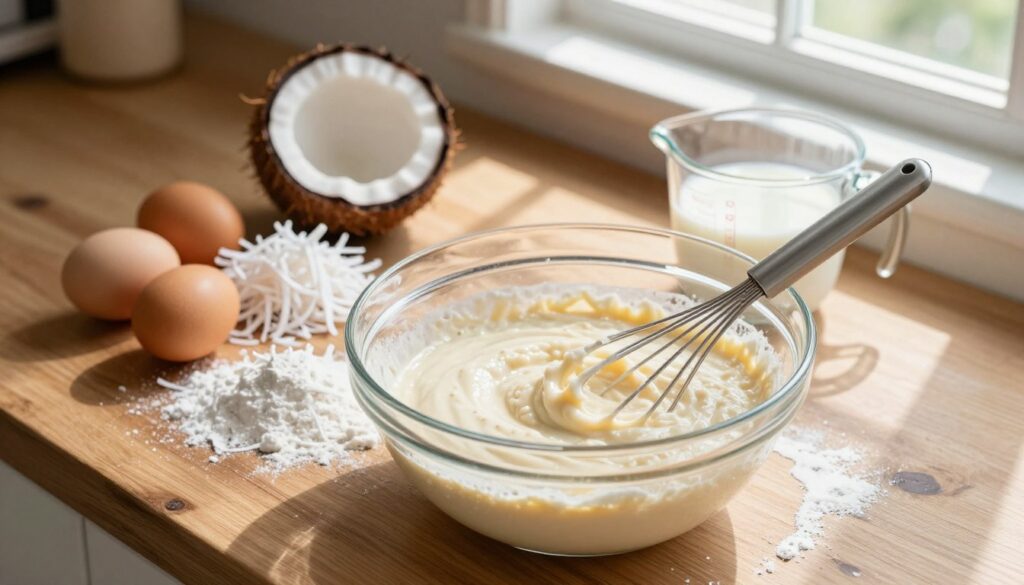
Use an electric hand whisk to beat the ingredients until the mixture becomes smooth and pale. The cream butter sugar stage is essential — it traps air and gives the sponge a light, airy crumb.
- Beat all ingredients together for a true all-in-one method; it saves time and reduces washing up.
- When adding eggs, use the mixing well addition approach: add slowly and keep whisking to avoid curdling.
- Ensure baking powder is evenly distributed so the rise is consistent across the tin.
| Tool | Action | Benefit |
|---|---|---|
| Electric hand whisk | Beat until pale | Even, airy mixture |
| Room-temp ingredients | Blend smoothly | Stable emulsion |
| All-in-one method | Combine then beat | Quick and reliable |
“Beat until pale and creamy — that visual cue tells you the batter is ready.”
Achieving the Ideal Bake
The moment the top goes a gentle gold is when you start checking for doneness. Place the 30x23cm tin in the centre of the oven and set a timer for 25–30 minutes. A steady oven and simple checks keep the sponge light and moist.
Testing with a Skewer
Use a clean skewer to test the centre. Gently insert it into the middle; if the skewer inserted comes out clean, the cake is ready.
If crumbs cling, return the tin for a few more minutes and check again. A golden skewer inserted into the sponge is your visual cue that the internal structure is set.
Avoiding Overbaking
Overbaking dries the crumb. Remove the tin as soon as the inserted centre comes clean and the top looks lightly golden.
Wait until it cools slightly before spreading icing so the surface holds the topping. For full details and the complete recipe, see the mary berry coconut cake recipe.
| Check | When | What it means |
|---|---|---|
| Bake time | 25–30 minutes | Typical window for an even bake |
| Oven position | Centre shelf | Best heat distribution for an even rise |
| Skewer test | After top is golden | If clean, centre comes clean and moisture is correct |
| Icing | After slight cooling | Prevents melting and soggy topping |
“A golden top and a clean skewer are the simplest signs of baking success.”
Preparing the Sweet Vanilla Icing
Whip up a pourable vanilla icing while the sponge is warm so it soaks in and sets. This glaze is quick to make and gives the cake a neat, glossy finish.
Start by sieving 250g of icing sugar to remove any lumps. Use a large bowl so you can whisk without spilling.
Gradually add 2–3 tbsp of warm water and 1 tsp of vanilla extract. Stir until the mixture is smooth and pourable.
The right thickness is key: the icing should coat the back of a spoon and slowly run off. If it’s too stiff, add a few drops of warm water. If it is too thin, fold in a little more icing sugar.
- Apply while slightly warm: pour the icing over the warm surface so it settles with a sheen.
- Enhance flavour: quality vanilla balances the sweetness and complements the desiccated coconut topping.
- Professional look: a smooth glaze creates tidy edges and helps the topping adhere.
“A silky vanilla icing is the simple secret to a great-looking tray favourite.”
Adding the Finishing Coconut Layer
The final flourish is the desiccated layer that gives the cake texture and a bright finish.
While the icing is still slightly tacky, sprinkle 75–100g of desiccated mix evenly over the surface of the tin. Aim for full coverage so every square gets a neat top.
Use your hand to press the topping lightly into the icing. This simple step helps the topping adhere so it does not fall off after the cake sets.
The contrast of the fine topping against the smooth icing makes each bite more interesting. Leave the tray to cool completely before slicing into neat squares.
| Step | Action | Tip |
|---|---|---|
| Sprinkle | 75–100g desiccated | Cover evenly for a professional look |
| Press | Use your hand gently | Helps topping stick to icing |
| Set | Cool fully in the tin | Slice when firm for clean squares |
“A light press with your hand secures the topping and keeps slices tidy.”
Cooling and Slicing for Perfect Squares
Leave cake cool completely in the tin before you do anything. This prevents the sponge from crumbling and keeps the icing from running.
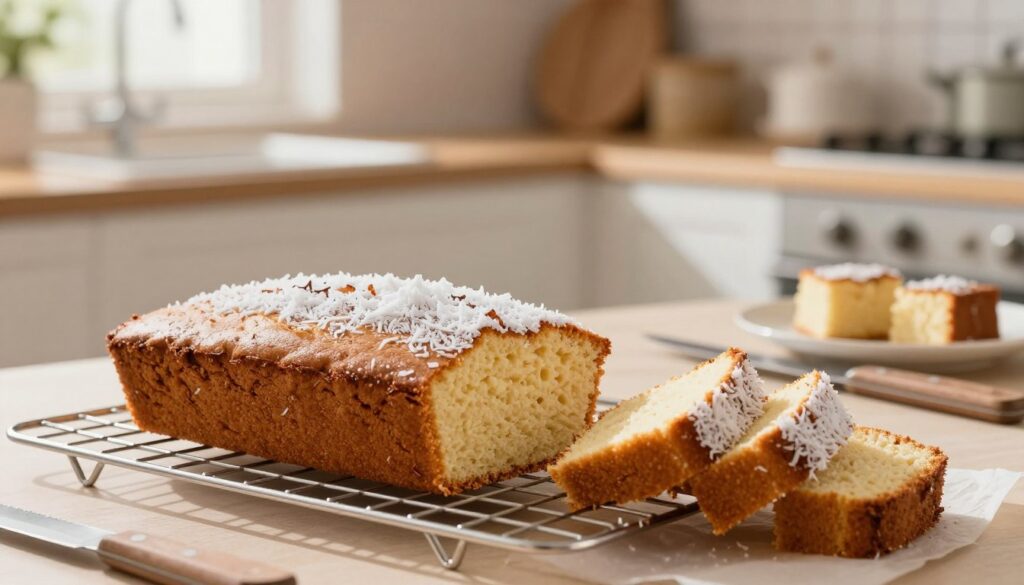
Allow the tray to rest for at least 30 minutes. In that time the icing will set and the coconut layer will bond to the surface. Patience here makes slicing much easier.
When the cake reaches room temperature, transfer to a board if you prefer. Use a sharp, long knife and wipe the blade between cuts for neat edges.
- Do not cut while warm — the icing will drag and the sponge may tear.
- Slice into uniform squares to make serving simple at a school event or tea party.
- A steady hand and a cooled tin give professional-looking pieces every time.
“Patience during the cooling phase is the key to those perfect, professional-looking squares.”
Troubleshooting Common Baking Issues
When your cake looks less than perfect, a quick check of technique and ingredients often helps. These short tips will guide you through common problems so you can rescue the batch and learn for next time.
Fixing a Dense Crumb
If the crumb turns out heavy, avoid overmixing the mixture next time. Beat only until combined; vigorous whisking can tighten the texture.
Check your baking powder — old raising agent gives a dense result. Use fresh baking powder and measure the flour and caster sugar accurately.
Preventing Sinking
Sinking often follows an oven door opened too early or an incorrect oven temperature. Use an oven thermometer and resist peeking in the first 20–25 minutes.
Level the batter in the tin baking parchment before placing it in the oven for the full minutes stated by the recipe.
Ensuring an Even Rise
For a steady rise, spread the mixture evenly in the tin and tap gently to remove large air pockets. A golden skewer inserted into the centre comes out clean when the cake is ready.
If the top browns too quickly, cover loosely with foil. Sprinkle the layer desiccated coconut while the icing sugar glaze is still tacky so the topping adheres.
| Issue | Quick Fix | Check |
|---|---|---|
| Dense crumb | Mix gently | Baking powder freshness |
| Sinking | Keep oven door closed | Oven temperature accuracy |
| Uneven rise | Level mixture in tin | Even distribution in tin |
“A golden skewer inserted into the cake is the best way to check for doneness.”
Creative Ways to Customise Your Tray Bake
A few simple additions make this recipe feel new while keeping the same easy method.
Swirl raspberry jam into the batter before baking to create fruity pockets that burst with flavour. For a bolder hit, add a thin layer of jam between the sponge and the vanilla icing once the cake has cooled slightly.
Add fresh lemon zest to the sponge for a bright, citrusy twist that cuts through sweetness and pairs well with the desiccated topping.
For a nutty variation, use almond extract instead of vanilla. This works especially well with the butter, sugar and milk in the base mix.
- Try different zests: lime or orange will change the character without altering the core recipe.
- Use jam sparingly: swirl a few teaspoons or add a thin layer to avoid soggy texture.
- Keep balance: the success of this mary berry coconut tray bake relies on the harmony of flour, butter and coconut, so add extras carefully.
“Small tweaks let you personalise the tray for any afternoon tea or charity event.”
Serving Suggestions for Afternoon Tea
Match textures and flavours to turn neat squares into a memorable tea-time centrepiece. Present the slices on a pretty platter to lift the simple cake into something special.
Pair with a warm cup of tea to balance the sweetness of the vanilla icing and the desiccated coconut. For guests who prefer a lighter touch, offer a small bowl of whipped cream or a dollop of raspberry jam.
Fresh tropical fruits such as pineapple or mango give a bright, juicy contrast to the rich, buttery sponge. A spoonful of lemon curd or a scattering of fresh berries adds useful acidity for a summer gathering.
- Serve alongside tea or coffee for classic afternoon tea appeal.
- Offer raspberry jam on the side so guests can personalise each square.
- Use fresh fruit and a neat platter to create a stylish spread.
“A simple presentation and a few fresh sides can make a homely tray slice feel utterly elegant.”
For another simple teatime recipe idea try the apple and almond cake as an alternative centrepiece.
Storing Your Cake to Maintain Freshness
How you store the cake matters as much as how you bake it.
To keep the slices fresh, place the cooled sponge in an airtight container at room temperature for up to 4 days.
Make sure the cake cool completely before sealing. Trapping heat creates condensation that will spoil the crumb.
- If warm weather threatens the glaze, refrigerate to stop the icing sugar glaze from softening.
- Freeze the un-iced sponge tightly wrapped for up to 3 months to protect flavour and prevent freezer burn.
- When serving from frozen, bring back to room temperature naturally or warm for a few minutes in the microwave.
| Method | Duration | Tip |
|---|---|---|
| Room temperature (airtight) | Up to 4 days | Keep away from direct heat and sunlight |
| Refrigeration | As needed | Use in warm climates to protect the icing |
| Freezer (un-iced sponge) | Up to 3 months | Wrap well to avoid odours and freezer burn |
“Proper storage preserves the moisture of the butter, sugar and milk so every slice tastes as good later as it did fresh.”
Conclusion
Mastering a few small techniques, such as the cream butter sugar stage and the mixing well addition, gives a reliably light result every time.
Check with a skewer inserted into the centre: a golden skewer inserted and the centre comes clean are your best signs of a perfect bake. Use the correct tin baking parchment and a traybake tin baking on the fan setting for even heat.
The mary berry coconut recipe balances simple flour, caster sugar and a touch of lemon zest to yield a moist crumb. Leave cake cool before slicing, finish with a layer desiccated coconut and store slices in an airtight box for up to 4 days.
Enjoy sharing this budget-friendly, classic cake with friends and family.
FAQ
What size tin should I use for this tray bake?
Can I substitute plain flour for self-raising flour?
How do I know when the cake is fully baked?
What’s the best way to prepare the tin to prevent sticking?
Can I use caster sugar instead of granulated sugar?
How should I mix the batter to avoid overworking it?
At what oven temperature should I bake, and does fan mode change the time?
How do I make the vanilla icing smooth and spreadable?
When should I add the desiccated coconut topping?
Can I spread raspberry jam between the sponge and the icing?
How long should I leave the cake to cool before slicing into squares?
My cake has a dense crumb — how can I prevent that?
What causes the centre to sink and how can I stop it?
How do I ensure an even rise across the tray?
Can I add lemon zest to the sponge or icing for extra flavour?
What are some easy variations to customise the recipe?
How should I store the tray bake to keep it fresh?
Mary Berry Coconut Tray Bake
This classic British favourite is a light, moist sponge topped with a sweet icing and a generous scattering of desiccated coconut. It has a gentle vanilla aroma that makes it perfect for afternoon tea or a school fundraiser.
Ingredients
- 225g self-raising flour
- 225g caster sugar
- 225g softened butter
- 4 large eggs
- 2 tsp baking powder
- 2 tsp vanilla extract
- 2 tbsp milk
- 250g icing sugar
- 2-3 tbsp warm water
- 75-100g desiccated coconut
Method
- Preheat your oven to 160°C (fan) or 180°C (conventional).
- Line a 30x23cm traybake tin with baking parchment.
- In a large bowl, combine the self-raising flour, caster sugar, softened butter, eggs, baking powder, vanilla extract, and milk.
- Use an electric hand whisk to beat the mixture until it turns pale and creamy.
- Pour the batter into the prepared tin and smooth the top.
- Bake in the preheated oven for 25-30 minutes, or until a skewer inserted into the center comes out clean.
- While the cake is baking, prepare the icing by sieving the icing sugar into a bowl and gradually adding warm water and vanilla extract until smooth.
- Once the cake is baked, allow it to cool slightly before pouring the icing over the top.
- Sprinkle the desiccated coconut evenly over the icing while it is still tacky.
- Allow the cake to cool completely in the tin before slicing into squares.