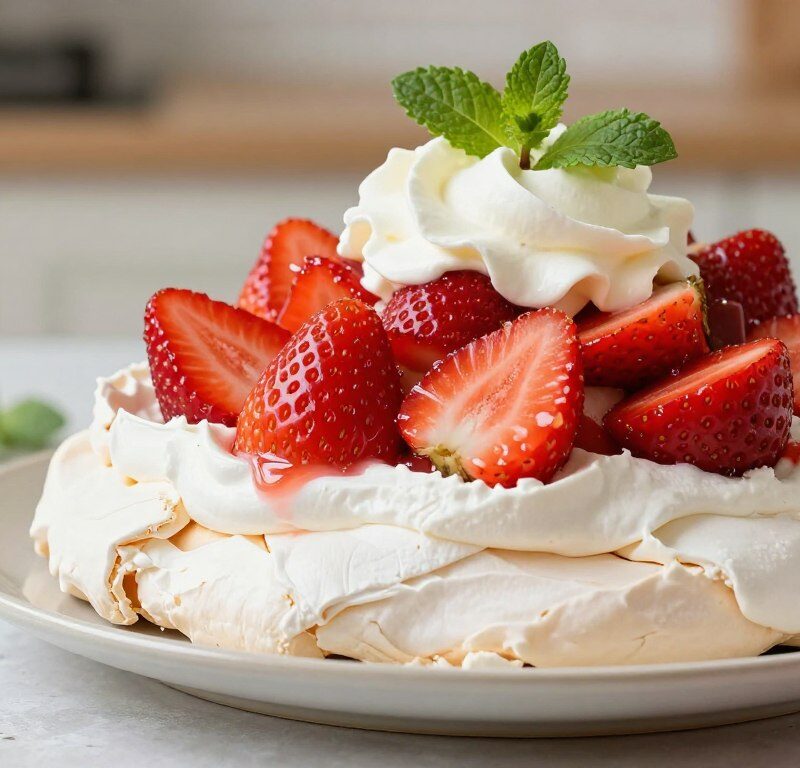
This timeless British dessert is a showstopper for summer gatherings and special occasions.
Mary Berry offers a classic recipe that hinges on precision: four large egg whites and 225g of caster sugar create the glossy meringue shell with a soft, marshmallow-like centre.
Start with a spotlessly clean bowl and room-temperature whites. Any grease or yolk will stop the mixture from whipping to the right volume.
The finished pavlova pairs a crisp, cloud-like shell with whipped cream and fresh strawberries for a tart, refreshing contrast to the sweetness.
Serve it chilled and it becomes an instant crowd-pleaser, perfect for dinner parties or a relaxed summer afternoon.
Key Takeaways
- Use four large egg whites and 225g caster sugar for stable, glossy meringue.
- Ensure the mixing bowl is completely clean and dry to allow proper whipping.
- Whipped cream and fresh strawberries balance the sweet, airy base.
- The texture should be crisp outside and soft like marshmallow inside.
- Ideal for summer events, this dessert impresses without complex steps.
The Timeless Appeal of a Mary Berry Strawberry Pavlova
The pavlova’s charm lies in its simple build and dramatic finish. It works as a striking centrepiece for summer BBQs and family get-togethers.
This recipe looks impressive but is easy to follow. Young helpers can whisk the whites or arrange the topping, turning baking into a shared activity.
Strawberries are the classic choice, yet the dessert adapts well. Use spiced plums in autumn or stewed rhubarb in spring. Swap to citrus in winter for bright, seasonal contrast.
Texture matters most: a crisp shell gives way to a soft, marshmallow-like centre. That contrast is the signature that keeps this dessert a crowd-pleaser over time.
- Versatile: seasonal fruit makes it year-round.
- Family-friendly: simple steps invite help from children.
- Showstopper: great presentation with little fuss.
| Season | Fruit Swap | Flavour Profile |
|---|---|---|
| Summer | Strawberries | Fresh, tart and classic |
| Autumn | Spiced plums | Warm, rich |
| Winter | Citrus segments | Bright, zesty |
| Spring | Stewed rhubarb | Tart, fragrant |
Essential Baking Equipment for Perfect Meringues
A few well-chosen pieces of equipment turn a tricky bake into a success.
Mixing Bowls and Whisks
Use a large, clean mixing bowl so your meringue gains maximum volume. A spotlessly dry metal or glass bowl works best.
A reliable whisk is crucial. A freestanding mixer speeds the job, but a good hand-held whisk will also create the structure you need.
“Precision tools cut mistakes and free you to focus on technique.”
Baking Trays and Parchment
Always line your baking tray with non-stick parchment paper rather than traditional greaseproof paper. This prevents the meringue sticking while it bakes in the oven.
If you lack a large baking tray, use a clean roasting tin or an upside-down grill pan, both lined with parchment.
- Keep a digital scale to measure sugar and egg whites exactly.
- Have a platter or cake stand about 32cm/13in to serve the finished dessert.
| Item | Why it matters | Alternative |
|---|---|---|
| Large bowl | Maximises air for the meringue | Deep glass mixing bowl |
| Whisk or mixer | Builds stable peaks quickly | Hand whisk if needed |
| Non-stick parchment | Prevents sticking during baking | Silicone baking mat (large size) |
| Digital scale | Ensures exact sugar-to-white ratio | Kitchen scales with tare |
Quality Ingredients for Your Pavlova Base
Choose the finest basics and you set the pavlova up to succeed.
The base needs exactly 4 large egg whites and 225g of caster sugar. Use room-temperature eggs so the whites whip more quickly and reach full volume.
Cornflour (2 tsp) and 2 tsp of white wine vinegar act as stabilisers. They help the meringue form a crisp shell while keeping the inside soft and marshmallowy.
Separate eggs carefully. Even a trace of yolk will stop the whites from reaching stiff peaks. Clean, dry bowls and metal or glass utensils give the best results.
- Measure caster sugar and vinegar precisely for reliable structure.
- Prefer mild white wine vinegar; it is easy to source and has a gentle flavour.
- Follow quantities exactly to recreate the signature texture of this dessert.
“Small tweaks to ingredients produce big changes in texture — measure with care.”
| Ingredient | Amount | Purpose |
|---|---|---|
| Large egg whites | 4 | Provides volume and structure |
| Caster sugar | 225g | Sweetens and stabilises the meringue |
| Cornflour | 2 tsp | Helps crisp the exterior; softens the centre |
| White wine vinegar | 2 tsp | Acidifies and stabilises the foam |
Preparing the Egg Whites for Maximum Volume
Transforming clear whites into stiff, glossy peaks takes patience and a good whisk. Start with large egg whites at room temperature for quicker, steadier volume.
Achieving Stiff Peaks
Begin whisking the egg whites on medium speed. Using a freestanding mixer will usually take a few minutes to reach the right texture.
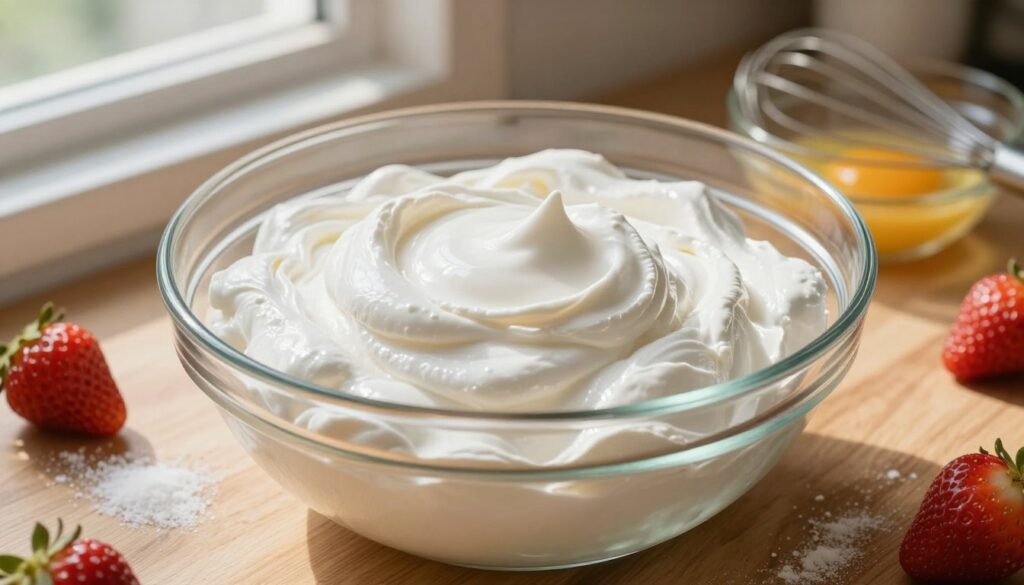
Watch for soft peaks first, then continue until the mixture holds firm, cloud-like peaks. The whites should be glossy and stable before any sugar is added.
- Volume tip: Whisk large egg whites in a clean, dry bowl until they hold their shape.
- Ready test: Turn the bowl upside down briefly — the whites must not slide out.
- Timing: The process often takes a few minutes; monitor closely to avoid over-whisking.
Mary Berry advises beginning with soft peaks and progressing to stiff peaks for a reliable base. Avoid whisking too long; over-whipped whites can make the meringue brittle rather than marshmallowy inside.
| Step | What to look for | Why it matters |
|---|---|---|
| Soft peaks | Edges lift but slump | Ready to start adding sugar slowly |
| Stiff peaks | Peaks stand upright, glossy | Gives structure for the pavlova base |
| Over-whisked | Dry, grainy texture | Leads to brittle meringue |
Incorporating Sugar and Stabilisers
Add the sugar slowly so the meringue stays glossy and lump-free. Use 225g of caster sugar and add it one teaspoon at a time. Wait until each spoonful has dissolved fully before adding the next.
Slowly adding sugar prevents graininess and helps the egg whites reach stable, glossy peaks. This method keeps the mixture smooth and prevents the meringue from weeping or collapsing as it bakes.
Once all the sugar is incorporated, combine 2 tsp cornflour with 2 tsp white wine vinegar. Gently fold this mixture into the whipped whites. Add the stabiliser mix slowly so you preserve the volume achieved during whisking.
The result should be thick, glossy and ready to be shaped on your prepared baking tray. This careful routine is the reason many cooks follow the same step-by-step approach.
- Add sugar to egg whites one teaspoon at a time until all 225g caster sugar is used.
- Gently fold in 2 tsp of cornflour mixed with 2 tsp white wine vinegar to stabilise the meringue.
- Stop folding when the mixture is thick, glossy and holds its shape for shaping.
| Action | Measure | Purpose |
|---|---|---|
| Add caster sugar | 225g, 1 tsp at a time | Prevents graininess; creates glossy meringue |
| Mix stabilisers | 2 tsp cornflour + 2 tsp white wine vinegar | Stabilises foam; keeps centre marshmallowy |
| Final check | Visual and texture | Thick, glossy, holds peaks; ready to shape |
Shaping and Baking the Meringue
Shape the glossy mixture on parchment using a measured guide so the finished pavlova looks even and bakes consistently.
Marking Your Circle
Draw a 23cm circle on baking paper to use as your template. Place the paper on a lined baking tray and stick it down with a small dab of meringue so it won’t slide.
Spread the mixture evenly inside the marked circle, leaving the centre slightly lower than the rim. This creates the well for cream and fruit later.
Building the Sides
Use a spoon to build the sides higher than the middle, forming a sturdy wall. Smooth the outside but keep a rustic, cloud-like texture on top for charm.
- Preheat the oven 160C / 140C fan / gas 3, then place the pavlova inside and immediately reduce the temperature so it cooks slowly.
- Bake for about an hour until the shell is pale beige and crisp on the outside.
- Allow to cool on the baking tray before moving to a serving plate to avoid cracking.
The Importance of Slow Cooling
Once the meringue has baked, patience during cooling is the real secret to success.
When the time is up, turn oven off and leave the pavlova to cool inside. Let it sit undisturbed for at least an hour so the dessert can settle slowly.
Keeping the oven door closed is vital. This steady drop in heat helps the shell stay crisp while the centre stays chewy and marshmallowy.
Some bakers even leave the pavlova to cool overnight in the oven. A slow finish avoids sudden temperature changes that cause cracking.
Before you add the cream, make sure the meringue is completely cold. Test by piercing the centre with a skewer—if dry throughout it is ready.
- Do this: turn the oven off and leave the pavlova become cold inside to protect the shell.
- If short on time: allow at least an hour rather than removing after a few minutes.
- Tip: slow cooling is the small step that perfects your baking result.
Preparing the Cream and Fresh Fruit Topping
Make the topping fresh and light by chilling all ingredients before you start. Cold cream whips more quickly and holds shape for a neat finish.
Selecting Seasonal Berries
Choose about 250g of fresh fruit — strawberries, raspberries or blueberries work well. Slice larger strawberries in half so they sit neatly on top.
Whip double cream until it reaches soft peaks. Stop just before it becomes too stiff; soft peaks spread easily and look luxurious.
- Whip time: usually a few minutes on medium — watch closely for texture, not clock minutes.
- Fixing over-whisked cream: fold in a little extra fresh cream or a splash of milk to soften and rescue the mix.
- Assembly: spread whipped cream over the cooled base, then arrange fruit attractively.
Chill the assembled dessert for an hour so flavours meld and the cream sets slightly before serving. This small pause lifts the whole presentation and taste.
Troubleshooting Common Meringue Issues
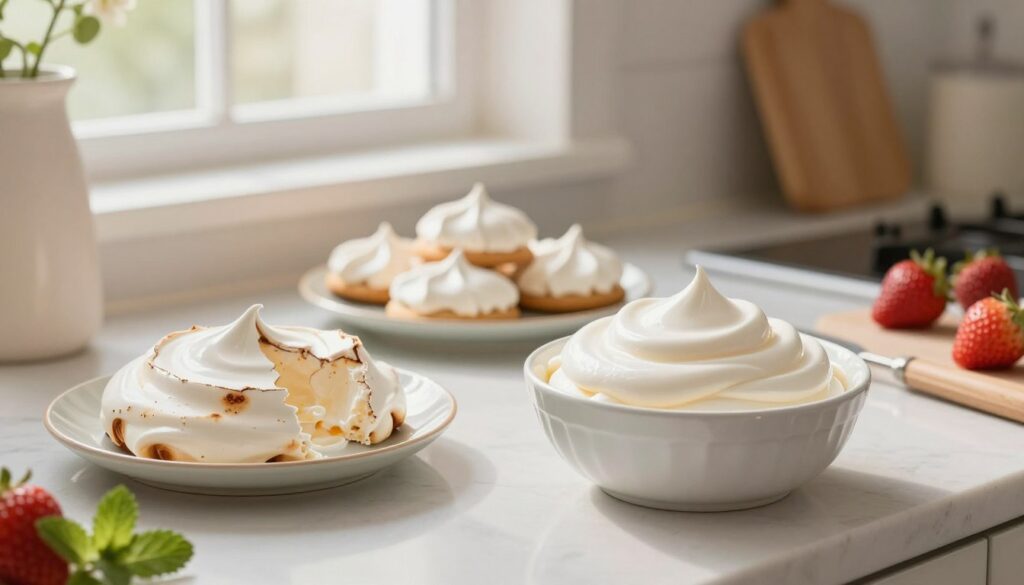
Small technique tweaks can stop a cracked shell or a weeping meringue in its tracks. Use the tips below to save a bake and keep your dessert looking and tasting its best.
Preventing Cracks
Keep the oven temperature low and after baking switch the oven off. Leave the pavlova to cool slowly with the oven door closed. Rapid cooling or a hot temperature will often cause cracks.
Avoiding Weeping
Weeping usually comes from adding sugar too quickly or under-whisked egg whites. Always add sugar gradually and make sure you whisk until glossy, stable peaks.
Fixing Loose Cream
If the cream is loose, continue to whisk until it reaches soft peaks. Stop once it holds shape; over-whisking will turn it grainy.
| Issue | Likely cause | Quick fix |
|---|---|---|
| Cracked shell | High oven temperature or fast cooling | Use low heat; cool inside oven with door closed |
| Weeping | Added sugar too fast / under-whisked whites | Add sugar slowly to egg whites; whisk to stiff peaks |
| Loose cream | Under-whipped cream | Whisk to soft peaks, stop before over-whipping |
Storage and Make Ahead Tips
Store the baked shell correctly and you can enjoy the perfect texture weeks later. An unfilled meringue base keeps well for up to one month if sealed in an airtight container or a well‑sealed plastic bag.
Humidity is the enemy of a crisp shell. Keep the container in a cool, dry place away from steam and strong smells. If you are making mini wreaths, bake two trays at once and swap their positions halfway through the baking time for even colour.
Assemble just before serving. Once you add cream and fruit the dessert will soften, so fill the base close to service time. This keeps the contrast between a crisp exterior and a soft centre.
- Prepare the meringue base up to one month ahead in an airtight container.
- If using a fan oven, reduce baking time slightly and monitor for even browning.
- Best eaten within a day or two after adding cream and fruit for optimal texture.
Conclusion
A well-baked meringue and a cool, calm finish transform simple ingredients into a showstopper.
Follow the recipe exactly: 4 large egg whites and 225g caster sugar give the right structure. Bake for one hour at oven 160C, then immediately reduce heat and let the base cool slowly inside the oven.
Gently pile whipped cream and fresh strawberries on top just before serving. A little cornflour and 2 tsp white wine vinegar keep the centre soft while the shell stays crisp.
With precise timing, the right temperature and care, this dessert will become the seasonal favourite that delights friends and family.
FAQ
How long should I whisk the egg whites to get stiff peaks?
When should I add the caster sugar?
What role do vinegar and cornflour play?
What oven temperature and time are best for baking?
Should I reduce the oven immediately after placing the meringue inside?
How do I mark the circle for shaping the meringue?
How do I build the sides without collapsing the centre?
Why is slow cooling important?
How much whipped cream and sugar should I use for the topping?
Which fruit is best for topping and how should I prepare it?
How can I prevent cracks in my meringue?
What causes weeping and how do I avoid it?
How do I fix loose cream once it’s on the meringue?
Can I make components ahead of time?
Mary Berry Strawberry Pavlova
This timeless British dessert is a showstopper for summer gatherings and special occasions, featuring a classic meringue shell with a soft, marshmallow-like center, topped with whipped cream and fresh strawberries.
Ingredients
- 4 large egg whites
- 225g caster sugar
- 2 tsp cornflour
- 2 tsp white wine vinegar
- 250g fresh strawberries
- double cream
Method
- Preheat the oven to 160C / 140C fan / gas 3.
- In a clean, dry bowl, whisk the egg whites until they hold soft peaks.
- Gradually add the caster sugar, one teaspoon at a time, whisking until the mixture is glossy and holds stiff peaks.
- Gently fold in the cornflour and white wine vinegar until just combined.
- Draw a 23cm circle on parchment paper and place it on a baking tray, securing it with a dab of meringue.
- Spread the meringue mixture inside the marked circle, building the sides higher than the center.
- Bake in the preheated oven for about 1 hour until the shell is pale beige and crisp.
- Turn off the oven and leave the pavlova to cool inside for at least 1 hour.
- Once cooled, whip the double cream until it reaches soft peaks.
- Spread the whipped cream over the cooled pavlova and arrange the fresh strawberries on top.
- Chill the assembled dessert for an hour before serving.