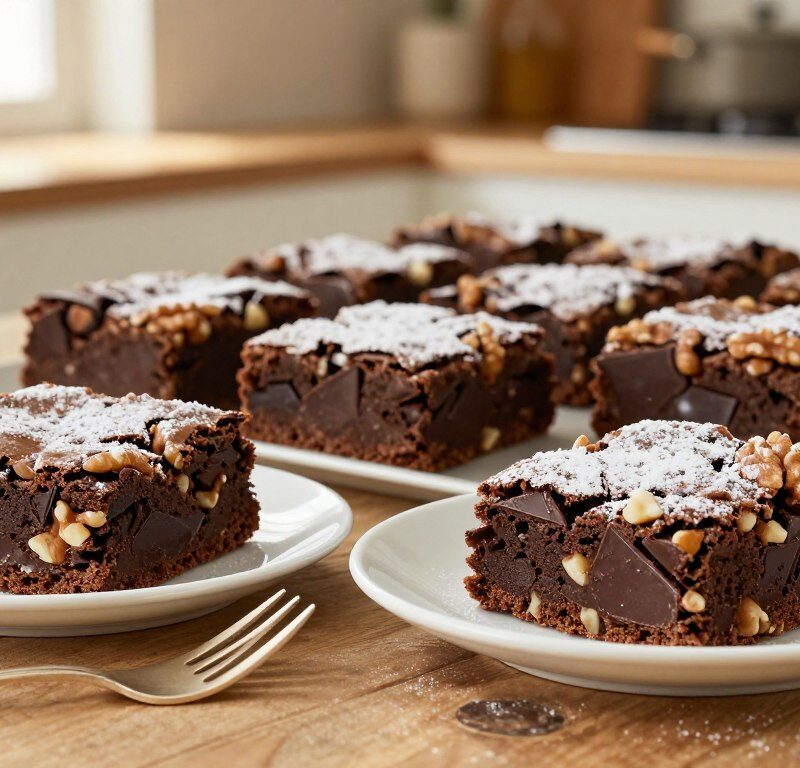
Classic British baking at its best, these fudgy squares blend deep cocoa richness with a crisp top and a chewy centre. The recipe uses high-quality dark chocolate, butter, caster sugar, eggs, flour and a splash of vanilla to create a reliably moist result.
This guide explains every practical step, from melting the chocolate gently to folding in roughly chopped walnuts for a pleasing crunch. You will learn simple timing tips to get the contrast between a glossy crust and a soft interior.
Ideal for afternoon tea or a dessert table, this treat differs from lighter cakes such as the apple cake and from biscuits often found in classic collections like the Baking Bible or the Ultimate Chocolate Roulade.
Follow the clear instructions and you will bake an impressive tray of treats that friends and family will enjoy time after time.
Key Takeaways
- Use good dark chocolate for the best flavour and texture.
- Gently melt chocolate and butter to avoid grainy batter.
- Roughly chop nuts for texture contrast and even distribution.
- Watch baking time to preserve a soft, fudgy centre.
- Serves well for afternoon tea or as a simple dessert offering.
Why You Will Love Mary Berry Walnut And Chocolate Brownies
These squares are built around real dark chocolate to give a rich flavour that cocoa powder alone cannot match. The result is a deep, satisfying taste that rewards good ingredients and simple technique.
The texture is the star: a slightly soft centre gives a luxurious mouthfeel while a lightly crisp top adds contrast. That mix of textures makes them feel more special than a standard sponge cake.
This recipe appears in the Baking Bible because it reliably delivers consistent results for home bakers. Slices hold their shape well, so these squares are ideal for sharing at gatherings.
- Uses real dark chocolate for depth of flavour.
- Fudgy centre and crisp top for perfect contrast.
- Walnuts add a subtle bitterness and satisfying crunch.
Essential Ingredients for Your Brownie Bake
Start with top‑quality bars and precise measures to build a reliably fudgy result. Good weight, clear roles for each item and a roomy mixing bowl make the process straightforward.
Selecting Quality Chocolate
Use 200g of dark chocolate with at least 70% cocoa for depth of flavour. Melt this together with 200g cubed butter in a heatproof bowl so the fats blend smoothly.
The recipe in the Baking Bible calls for 250g caster sugar and 3 large room‑temperature eggs to give structure and shine to the batter.
Choosing the Right Walnuts
Fold in 150g of roughly chopped walnuts for crunch. If you prefer a sweeter contrast, try 100g white chocolate chips instead.
Combine 100g plain flour with 50g cocoa powder to set density without making the cake dry.
| Ingredient | Quantity | Role | Tip |
|---|---|---|---|
| Dark chocolate | 200g (70%+) | Flavour & richness | Melt with butter in a bowl |
| Butter | 200g | Fudgy texture | Use high quality, cubed |
| Sugar / Eggs | 250g / 3 large | Sweetness & structure | Eggs at room temperature |
| Flour / Cocoa powder / Walnuts | 100g / 50g / 150g | Density, chocolate lift, crunch | Roughly chop nuts, sift dry mix |
Preparing Your Kitchen and Equipment
Before you touch the scales, make sure your oven is ready and your tin is lined for swift action.
Preheat oven to 180°C (350°F) as mary berry advises. Starting with the oven at the right temperature helps the top set while the centre stays fudgy.
Line a 20 × 30 cm baking tin with parchment so the bake lifts out cleanly. A well‑prepared tin prevents the edges from breaking and makes slicing easier.
Gather all tools: a heatproof bowl, a saucepan, scales, spatula and a sieve. Have your mixture prepared tin ready so you can move quickly from mixing to baking, following the Baking Bible method.
| Item | Purpose | Tip |
|---|---|---|
| Oven | Even heat for consistent bake | Check calibration; aim for 180c |
| 20×30 cm tin | Shape and depth control | Line with parchment for easy lift |
| Heatproof bowl & saucepan | Melting chocolate and butter | Use a gentle simmer; avoid direct heat |
| Scales & sieve | Accurate measures, lump‑free dry mix | Weigh ingredients before starting |
Organise your workspace and check oven settings one last time. Good prep is a hallmark of stress‑free baking and often decides the final texture.
Melting the Chocolate and Butter
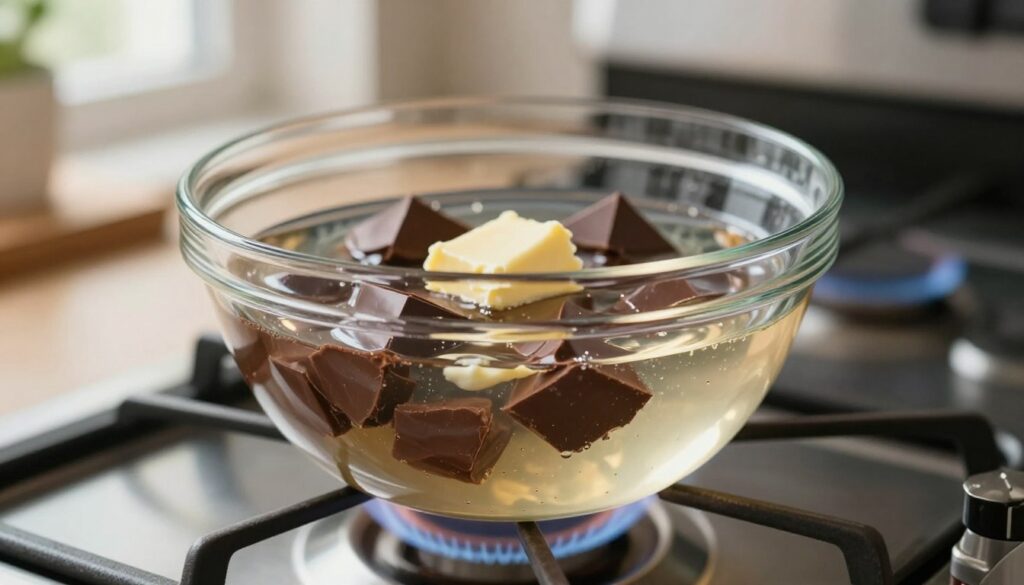
Gently warm the chocolate butter so it forms a smooth, glossy base for the batter. Place a heatproof bowl over a saucepan of simmering water and let the gentle heat do the work.
Using a Heatproof Bowl
Follow the Baking Bible approach that mary berry recommends: set the bowl so steam, not boiling water, touches the base. Stir occasionally with a wooden spoon to keep the mixture even.
Once the chocolate and butter are fully melted, remove heat straight away. This avoids overheating and keeps the mixture silky rather than grainy.
Allow the liquid to cool for a few minutes before you add the sugar. Have a clean tin nearby, but do not pour the mixture until all other components are ready and combined.
Tip: a proper heatproof bowl gives safe, even heat distribution and helps you control the temperature throughout the melting stage.
Combining the Wet Ingredients
Once the melted base has cooled slightly, it’s time to bring the wet ingredients together for a glossy, stable batter.
Remove the bowl from the saucepan of simmering water and stir in 250g caster sugar until fully incorporated. If the mix still feels warm, wait a few minutes before proceeding.
Beat in the three large eggs one at a time. Adding each egg separately helps form a strong emulsion and traps the right amount of air for a fudgy texture.
Stir in 1 teaspoon of vanilla extract for a gentle aromatic lift. Keep the heatproof bowl stable while whisking to avoid splashes and to keep your workspace tidy.
Mix until the batter is smooth and glossy. This shows the sugar has dissolved and the wet ingredients are well combined. The Baking Bible method emphasises this step because it shapes the final crumb.
| Step | Purpose | Tip |
|---|---|---|
| Add sugar | Dissolves into chocolate butter base | Stir off the heat until smooth |
| Beat eggs one at a time | Create a stable emulsion | Use room temperature eggs; whisk steadily |
| Add vanilla extract | Enhances flavour depth | Combine near the end to keep aroma |
Folding in the Dry Components
To keep the bake dense and fudgy, introduce the dry mix in stages and fold with care.
Sift 100g plain flour and 50g cocoa powder straight into the cooled wet batter. This removes lumps and helps the dry mix blend evenly.
Use a large metal spoon and gently fold. Work slowly with broad strokes so the mixture stays thick rather than airy.
Some cooks suggest using self-raising flour as a shortcut, but the Baking Bible method prefers plain flour for a denser result. Avoid overmixing; extra stirring develops gluten and can make the final tray tough.
“Fold until the batter is uniform, dark and glossy — ready to be spooned into the mixture prepared tin.”
| Action | Why | Tip |
|---|---|---|
| Sift flour & cocoa powder | Remove lumps; even distribution | Sift directly over bowl |
| Fold with a metal spoon | Preserve density; avoid air | Use broad, gentle strokes |
| Stop when smooth | Prevent gluten development | Leave a few streaks rather than overmix |
Once the mixture prepared is smooth, you are ready to add the crunchy elements and transfer to your tin for baking.
Adding the Crunchy Walnut Texture
Finish the batter by folding in 150g of roughly chopped nuts—this step gives the tray its signature crunch.
First, toss the nuts in a tablespoon of flour. This small trick, noted in the Baking Bible, helps stop them sinking to the bottom of the tin.
Fold the nuts in with broad, gentle strokes so they spread evenly through the thick batter. Aim for pieces that give a clear bite but do not obstruct slicing.
Walnuts bring a subtle bitterness that lifts the sweetness of the chocolate, giving a more complex flavour across every square.
- Chop to even, bite-size pieces.
- Toss with a little flour.
- Fold gently into the cooled batter, then pour into the prepared tin.
“Distribute nuts evenly so each portion has texture and balance.”
| Addition | Amount | Purpose |
|---|---|---|
| Roughly chopped nuts | 150g | Crunch and subtle bitterness |
| Flour toss | 1 tbsp | Prevents sinking in the tin |
| Chop size | Small to medium | Noticeable crunch; easy slicing |
Baking Your Brownies to Perfection
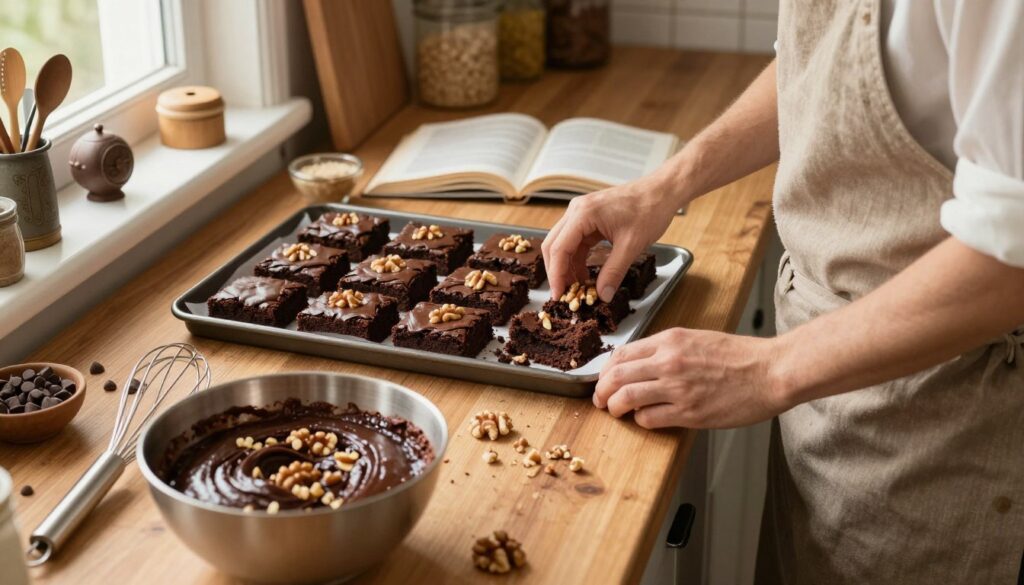
Timing and position in the oven matter more than you might think. Preheat to 180c and place the prepared tin in the centre shelf so heat reaches every corner of the tray. Set a timer and watch the bake minutes closely.
Monitoring the Oven Temperature
Keep the oven steady at 180c. A small fluctuation can change how the top sets. Use an oven thermometer if you have one.
Checking for the Perfect Centre
Mary Berry advises 25–30 minutes at 180c for a glossy, papery top. Insert a skewer into the centre; it should come out with a few moist crumbs, not clean.
If the surface looks set but the middle feels slightly soft, remove the tray. The eggs and chocolate will continue to firm as the mixture prepared cools in the tin.
“Remove while slightly soft — this keeps the tray moist and fudgy.”
| Check | What to look for | Action |
|---|---|---|
| Surface | Papery, glossy top | Consider timer reached; test with skewer |
| Skewer test | Moist crumbs, not clean | Remove; cool in tin |
| Overbake risk | Dry edges or cake-like centre | Shorten bake minutes next time |
Cooling and Slicing for the Best Results
Cooling the bake in its tin is the single most forgiving step for neat, fudgy squares. Allow the tray to rest until it reaches room temperature so the centre can finish setting.
Follow mary berry’s clear advice and leave the slab undisturbed in the tin. The top will remain firm and slightly cracked while the centre stays slightly soft at first.
Once cool, turn the tin out or slice in situ with a sharp knife. The Baking Bible recommends wiping the blade between cuts to keep edges clean and precise.
If you try to cut while warm, the pieces will crumble and lose shape. Patience here gives a professional finish and consistent texture through each square.
“Allow brownies to cool completely in the tin; it saves time and avoids frustration.”
- Cool in the tin until room temperature.
- Use a hot, clean knife and wipe between cuts.
- Slice into even squares and serve once set.
Expert Tips for Fudgy Brownie Success
Small adjustments in timing and temperature make the difference between fudgy squares and a dry, cakey slice.
Avoiding overbaking: cut a few bake minutes if your tray turns out cakey. Test with a skewer — remove when the centre is slightly soft. The residual heat will finish the set as the slab cools.
Achieving the ideal texture
Do not overbeat the eggs. Too much whisking adds air and lifts the crumb into cake territory. Use good plain chocolate and real butter for depth and a glossy top.
Preventing crumbling
Cool in the tin until fully room temperature. This stops the centre from collapsing and helps clean slicing into neat squares. Wipe a hot, sharp knife between cuts for crisp edges.
- Fold gently to keep the batter dense.
- Measure flour and cocoa powder accurately.
- If the top cracks too much, lower the oven by 10°C next time.
“Serve slightly warm with a scoop of ice cream for a simple, indulgent finish.”
Creative Serving Suggestions
Serve a warm square with a scoop of vanilla ice cream to create a classic contrast of temperatures and textures. The cold cream and warm centre make each mouthful feel indulgent.
For a pretty finish, dust with icing sugar and add a small dollop of whipped cream to lift the richness. A few extra chocolate chips or white chocolate chunks folded into the batter before it goes into the tin will up the decadence.
Pair portions with a strong cup of coffee for the best flavour balance. If you’re hosting, lay out a platter with these squares beside easter biscuits or a light lemon cake for variety.
Try simple flavour twists: a scatter of orange zest or a peanut butter swirl adds personality and keeps guests talking.
“Serve slightly warm with ice cream for the ultimate chocolate experience.”
| Serving | Effect | Tip |
|---|---|---|
| With vanilla ice cream | Warm–cold contrast | Serve immediately after slight cooling |
| Icing sugar & whipped cream | Elegant, lighter finish | Dust just before serving |
| Extra chips or white chocolate | More gooey pockets | Add to batter; bake in tin as usual |
| Platter with other treats | Offers variety for guests | Include easter biscuits or lemon cake |
- Serve warm for gooey centre.
- Pair with coffee or ice cream.
- Present on a nice platter for the ultimate chocolate moment.
Conclusion
In conclusion, a few careful steps turn everyday baking into an impressive, shareable treat. Follow the method here and you will get a crisp top with a soft, fudgy centre.
mary berry Walnut and Chocolate Brownies remain a timeless favourite and this recipe makes them easy to master. Use good ingredients and be patient while the tray cools for best results.
Whether you enjoy the Ultimate Chocolate Roulade or a simple apple cake, this brownie is a must for your collection. We hope this guide inspires you to bake and share these rich squares soon.
FAQ
What temperature should I preheat the oven to for these brownies?
Can I use plain chocolate or should I use cocoa powder?
How long should the brownies bake for?
Do I need self-raising flour or plain flour?
How should I melt the chocolate and butter safely?
Can I add nuts other than walnuts?
What’s the best way to combine the wet and dry ingredients?
How long should I cool the tray before slicing?
Any tips for preventing overbaking and crumbling?
Can I use a mixture prepared from a packet or should I follow the recipe from scratch?
How do I store leftover brownies?
What serving suggestions work best with these fudgy brownies?
How can I achieve the glossy, crackly top on my brownies?
Mary Berry Walnut And Chocolate Brownies
Classic British baking at its best, these fudgy squares blend deep cocoa richness with a crisp top and a chewy centre. Ideal for afternoon tea or a dessert table.
Ingredients
- 200g dark chocolate (70%+)
- 200g butter
- 250g caster sugar
- 3 large eggs
- 100g plain flour
- 50g cocoa powder
- 150g roughly chopped walnuts
- 1 teaspoon vanilla extract
Method
- Preheat the oven to 180°C (350°F) and line a 20 × 30 cm baking tin with parchment.
- Melt the dark chocolate and butter together in a heatproof bowl over a saucepan of simmering water until smooth.
- Remove from heat and allow to cool slightly before stirring in the caster sugar until fully incorporated.
- Beat in the eggs one at a time, mixing well after each addition, then stir in the vanilla extract.
- Sift the plain flour and cocoa powder into the mixture and gently fold until combined.
- Toss the chopped walnuts in a tablespoon of flour and fold them into the batter.
- Pour the batter into the prepared tin and smooth the top.
- Bake in the preheated oven for 25-30 minutes, until the top is glossy and a skewer inserted into the center comes out with a few moist crumbs.
- Allow the brownies to cool in the tin until room temperature before slicing into squares.